
The best way to keep in touch with Hand Picked Hotels is to sign up to our news, offers and events below. Please do read our Privacy Policy for more information on how we use your data and you can of course opt out at any time.
Gardens Built to Endure
How thoughtful planting can help Channel Island gardens recover, adapt and thrive after extreme weather. The storm of 9 January and its 95mph winds left devastation in its wake across the Channel Islands. In Guernsey alone, up to 2,000 trees were lost. For gardeners it was a stark reminder of the power of Atlantic weather and the importance of planting wisely.
How thoughtful planting can help Channel Island gardens recover, adapt and thrive after extreme weather. The storm of 9 January and its 95mph winds left devastation in its wake across the Channel Islands. In Guernsey alone, up to 2,000 trees were lost. For gardeners it was a stark reminder of the power of Atlantic weather and the importance of planting wisely.
Storms like this challenge even the most established landscapes, yet they also offer an opportunity to rethink how we design our gardens. Choosing the right plant in the right place, understanding soil conditions and learning from plants that thrive in similarly exposed climates can help create gardens that not only recover, but flourish.
Start with strong foundations
Healthy soil remains the foundation of resilience. Strong roots depend on good structure, drainage and nutrients. Organic matter such as compost or well rotted manure improves soil health, helping it retain moisture in dry conditions while allowing excess water to drain in wetter periods. A layer of organic mulch, around five centimetres deep and kept clear of stems, helps protect the soil surface during dry spells.
Planting depth is another critical factor. Trees planted too deeply struggle to establish stable root systems. Gardeners often describe the trunk of a tree as an arm and the roots as the hand gripping the soil. If the wrist sits too low, the roots cannot anchor properly. A useful reminder often shared among horticulturists is simple. Plant them low they will not grow. Plant them high see them fly. In practice, the root junction should sit at soil level or slightly above it.
Tree structure also influences resilience. Traditional standard trees with a single clear trunk and a high canopy can behave like sails during strong winds. Their height and exposed structure increase the risk of snapping or uprooting, particularly when soils are saturated. Multi stem trees offer a more stable alternative. With a lower centre of gravity and a naturally shared load between stems, they are better able to absorb gusts and recover if one stem is damaged. Species such as birch, amelanchier, hawthorn and ornamental cherries perform particularly well in this form, bringing movement and texture while remaining well suited to coastal conditions.
Diversity within planting schemes is equally important. Gardens that combine trees, shrubs, perennials and groundcover spread risk across different plant types. If one group struggles during extreme weather, others will often recover quickly, allowing the garden to regain its structure.
Early care pays dividends
Even resilient plants benefit from thoughtful care during their early years. Young trees should be supported until their roots are established, typically for the first two to three years. This can be achieved with traditional double staking, underground anchor systems or wire guy ropes with a stem collar positioned above ground level. Pruning also plays an important role. Removing dead wood, thinning dense growth and shaping the canopy reduces wind resistance and lowers the risk of breakage during storms, particularly where trees grow close to paths or buildings.
In some cases more traditional techniques such as pollarding or coppicing can be effective. Pollarding involves cutting trees back annually to a framework of branches higher up the trunk, while coppicing removes growth at ground level every few years to encourage vigorous regrowth.
The overall design of a garden can also influence how it responds to storms. Windbreaks created from hedges, dense shrubs or screens can slow strong gusts before they reach more delicate planting areas. Planting in clusters rather than isolated specimens allows plants to support each other structurally, while taller species positioned on the windward side can act as natural shields. Groundcover planting also helps bind the soil and reduce erosion during heavy rainfall.
Making the right selection matters
Changing weather patterns are prompting gardeners to think more carefully about plant selection. Storms often bring intense winds, driving rain and salt spray, particularly in coastal locations. Looking to plants that naturally thrive in similar climates can provide valuable guidance.
Coastal regions of New Zealand and South Africa experience conditions remarkably similar to those found in the Channel Islands. Many plants from these regions have evolved to cope with wind, salt air and poor soils, developing flexible stems, waxy foliage and strong root systems that help them survive in exposed environments.
New Zealand offers several robust coastal plants. Pittosporum tenuifolium grows quickly with flexible branches and salt resistant leaves, while Griselinia littoralis creates an excellent coastal hedge with thick leathery foliage. Leptospermum scoparium, better known as the Manuka tree, famously clings to the cliffs of Milford Sound where it endures relentless wind and rain. Olearia traversiorum, the Chatham Island tree daisy, offers silvery foliage well suited to exposed sites.
Architectural plants such as Phormium, or New Zealand flax, also perform well thanks to strong fibrous leaves that bend rather than snap. Grasses are another reliable option. Anemanthele lessoniana, sometimes called pheasant’s tail grass, forms graceful clumps of arching foliage that shift from green to warm copper tones through the seasons.
South Africa provides another source of resilient plants shaped by similarly demanding environments. Dietes performs well in wet and windy conditions, while restios offer architectural grass like forms adapted to storm prone coastlines. Species such as Watsonia pillansii, Euclea racemosa, Dodonaea viscosa and various Leucadendrons bring both colour and resilience.
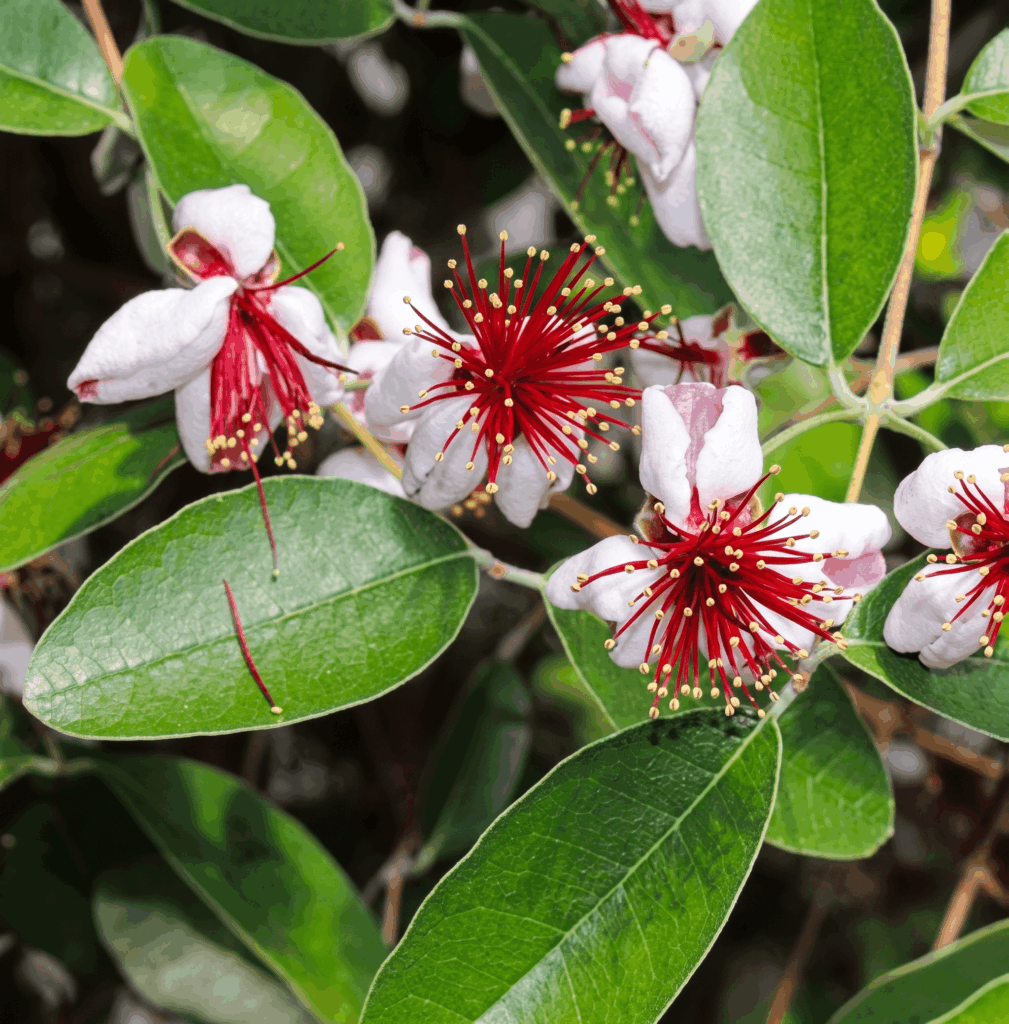
Other regions also contribute inspiration. Acca sellowiana, known as pineapple guava or feijoa, produces distinctive red flowers and grows well in sheltered coastal settings. Luma apiculata, the Chilean myrtle, is admired for its smooth peeling bark and delicate white flowers.
Despite their diverse origins, many of these plants share similar characteristics. They tend to have small leathery or waxy leaves that resist salt damage, flexible stems that bend rather than break and strong root systems that anchor them securely. When combined with thoughtful design and layered planting, these species help create gardens that absorb the force of storms rather than fight against them.
While no garden can ever be completely storm proof, careful planting and informed plant selection can dramatically improve resilience. By working with nature rather than against it, Channel Island gardens can continue to recover, adapt and thrive.